pink tie planner
unifying degree planning for UW math majors
solo researcher, designer, developer
4 months (w26)
figma, claude design, claude code, cursor
live at pinktieplanner.com
This end-to-end project was made as part of UW/UX's design mentorship, marking the start of my pivot from software/data to product design.
problem
Degree planning for math students is hard.
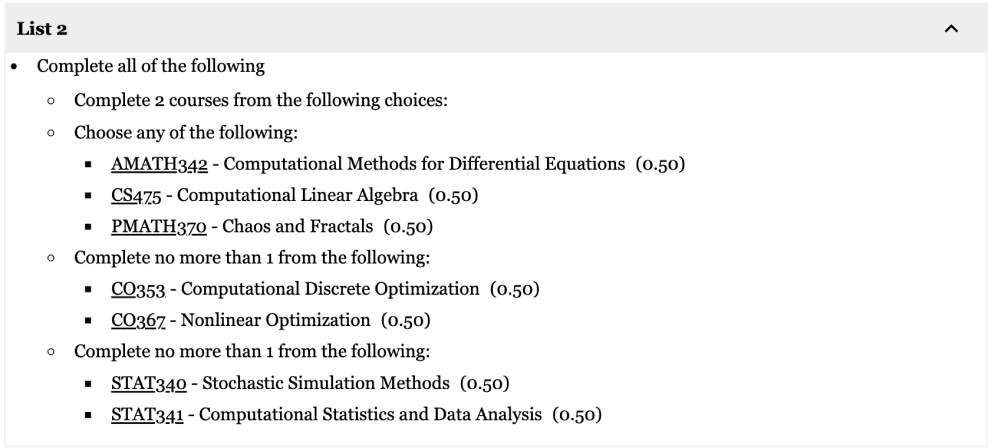
Honours Math students declare one of 16 majors, each with confusing nested requirements, co-op sequences that don't always align with when courses are offered, and hundreds of possible double major and minor combinations.
research
I interviewed 10 UW math students across a diverse range of years and majors to understand how math students currently navigate degree planning, surfacing 7 pain points:
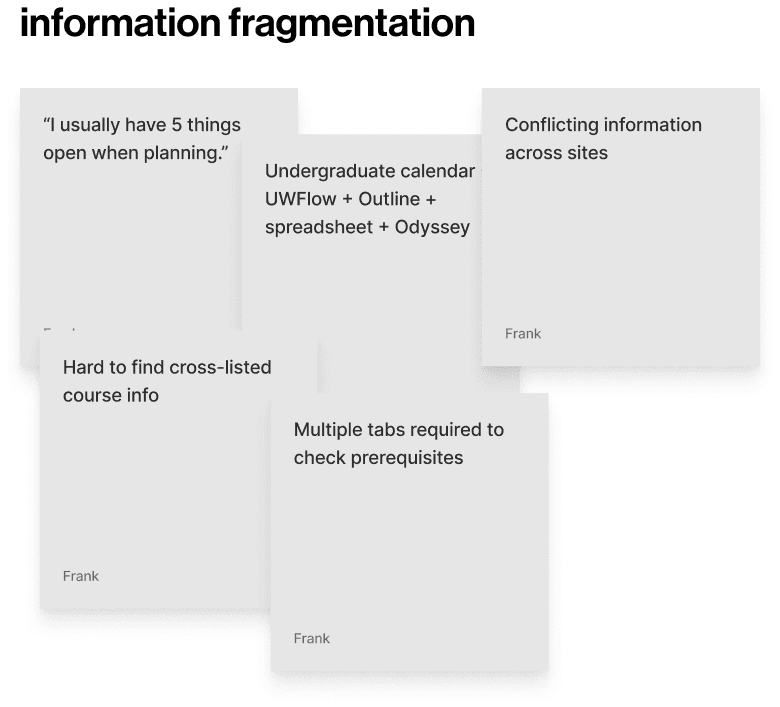
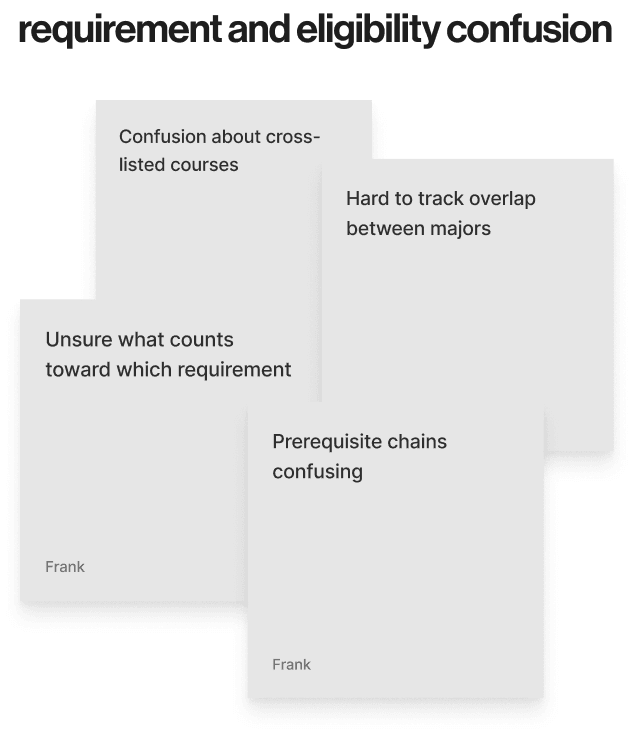
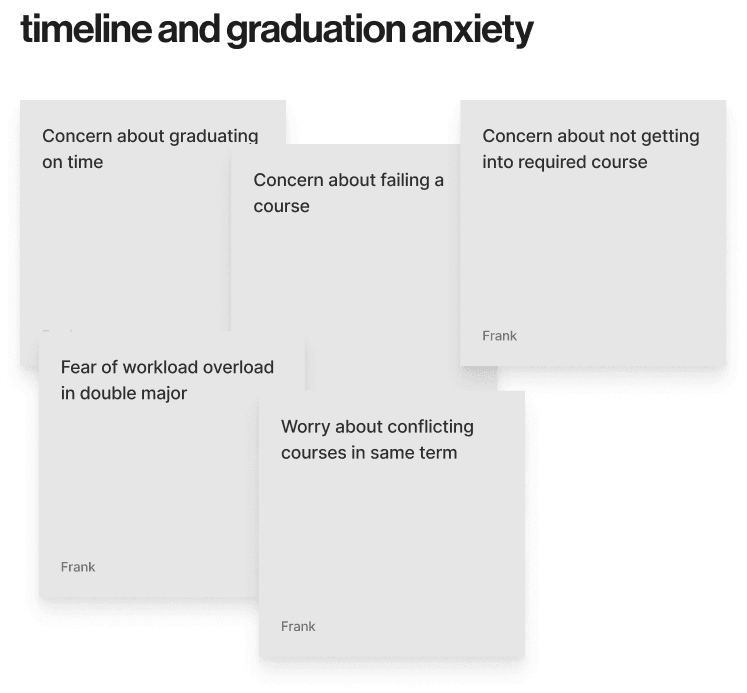
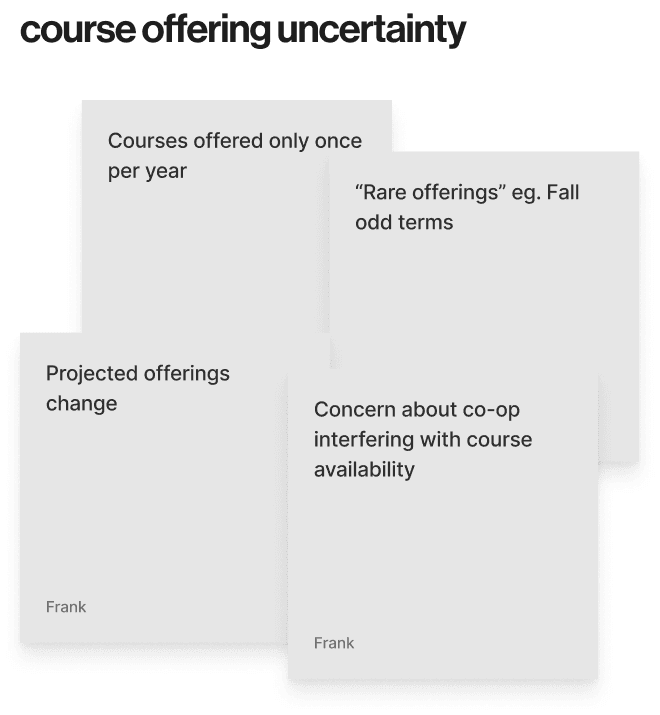
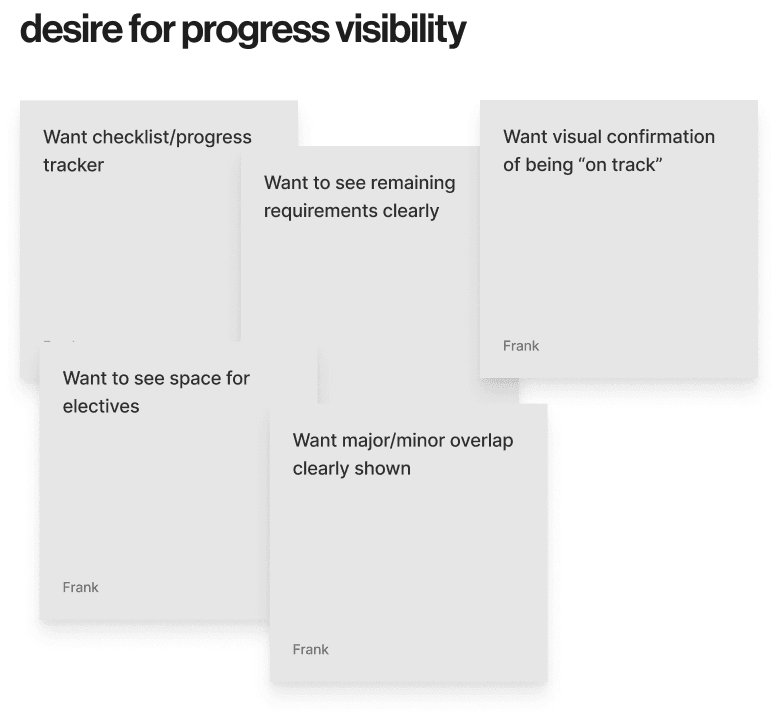
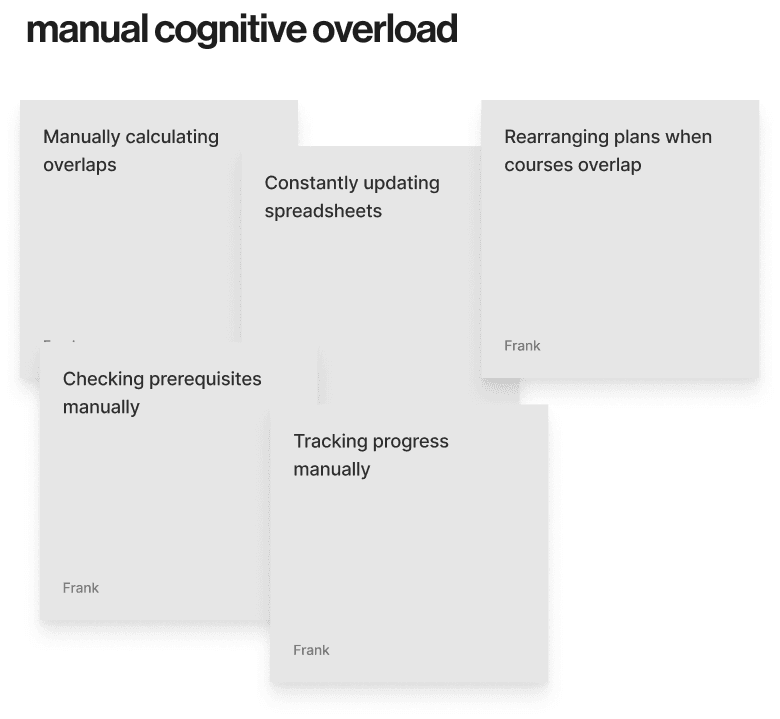
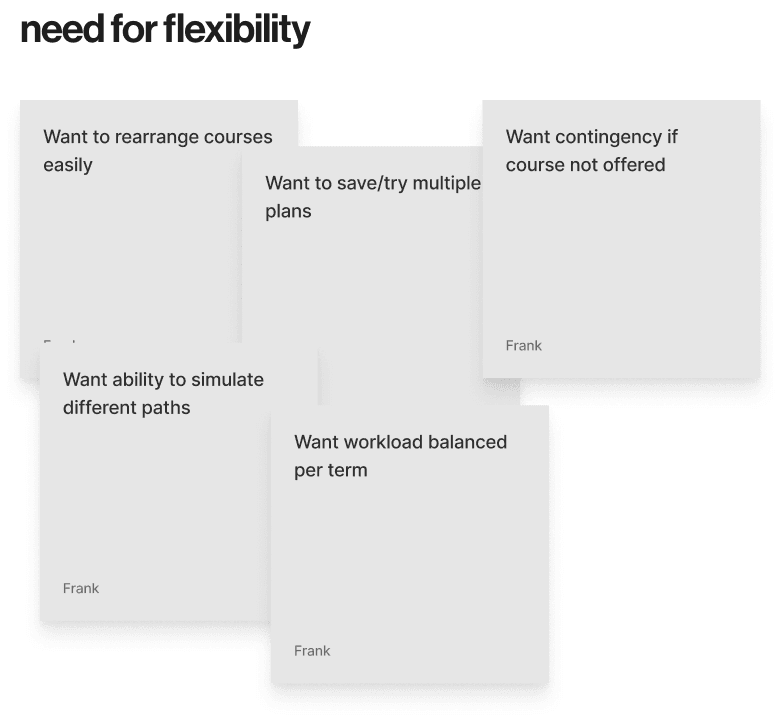
7 personas also emerged from the interviews, representing different archetypes each with different goals, behaviours, and pain points:
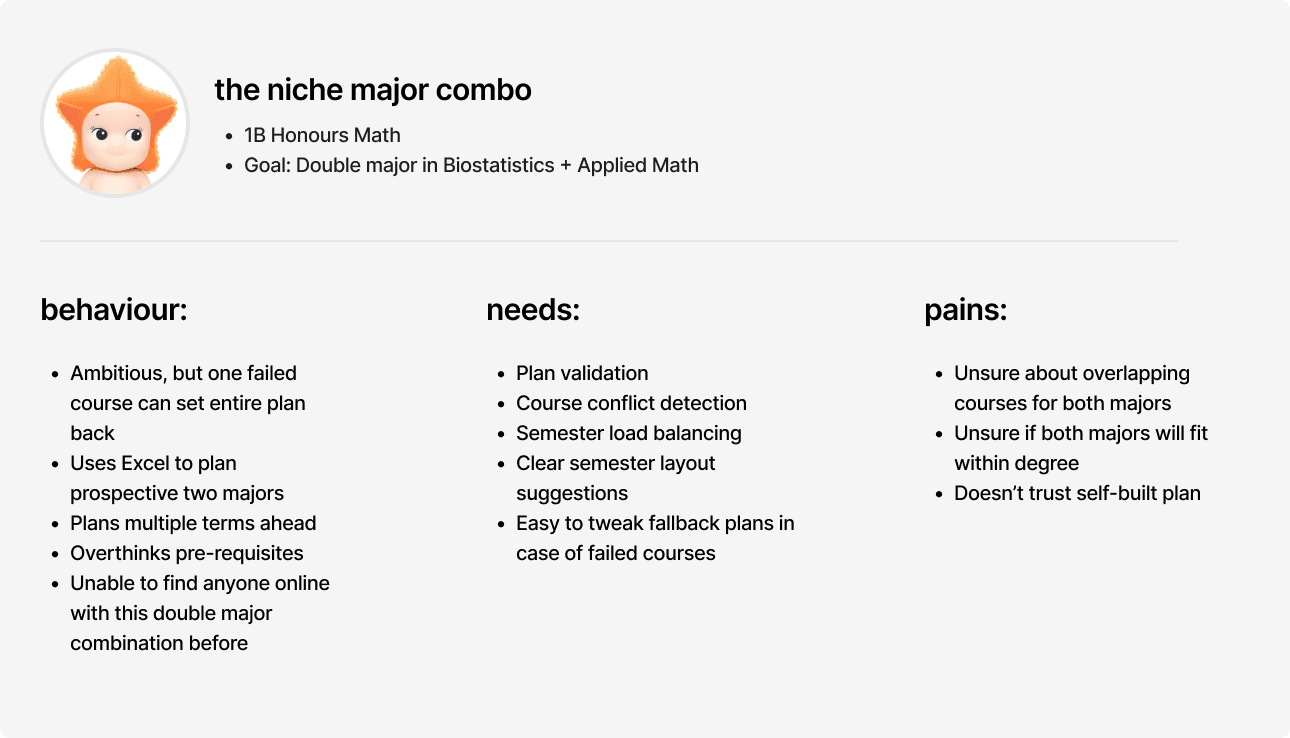
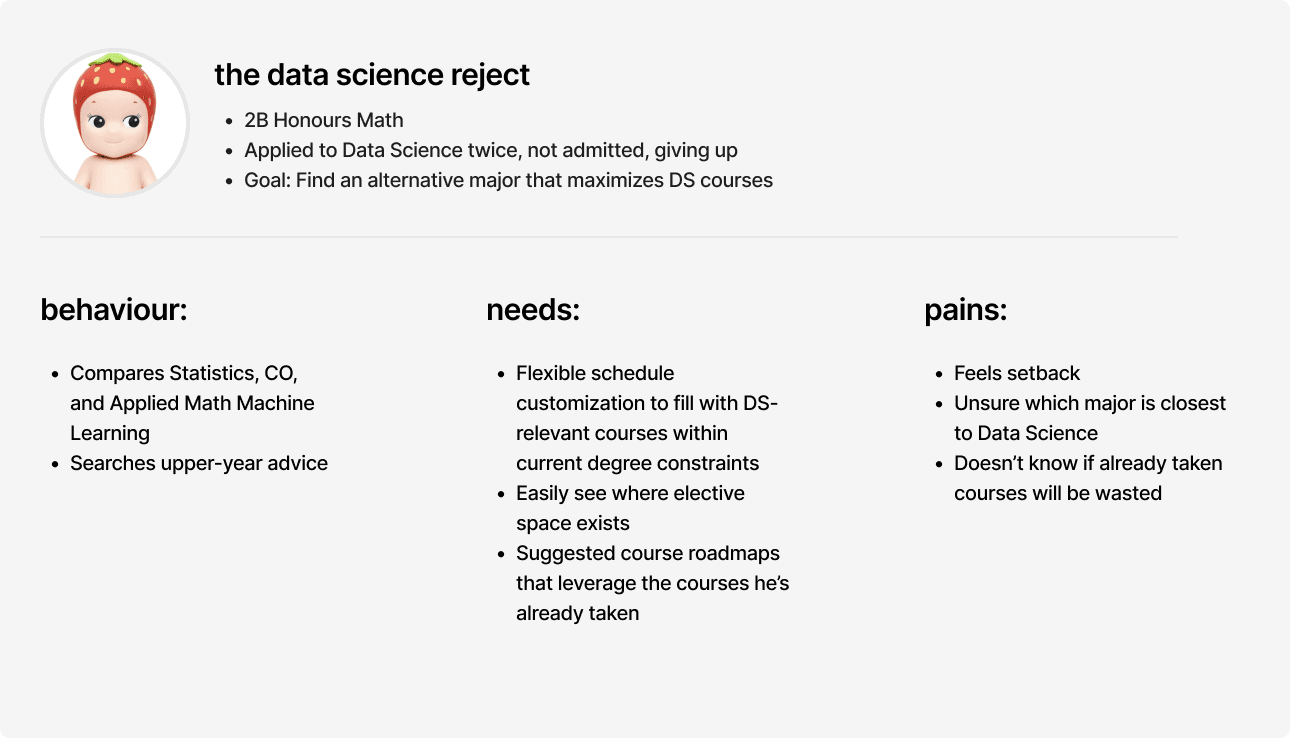
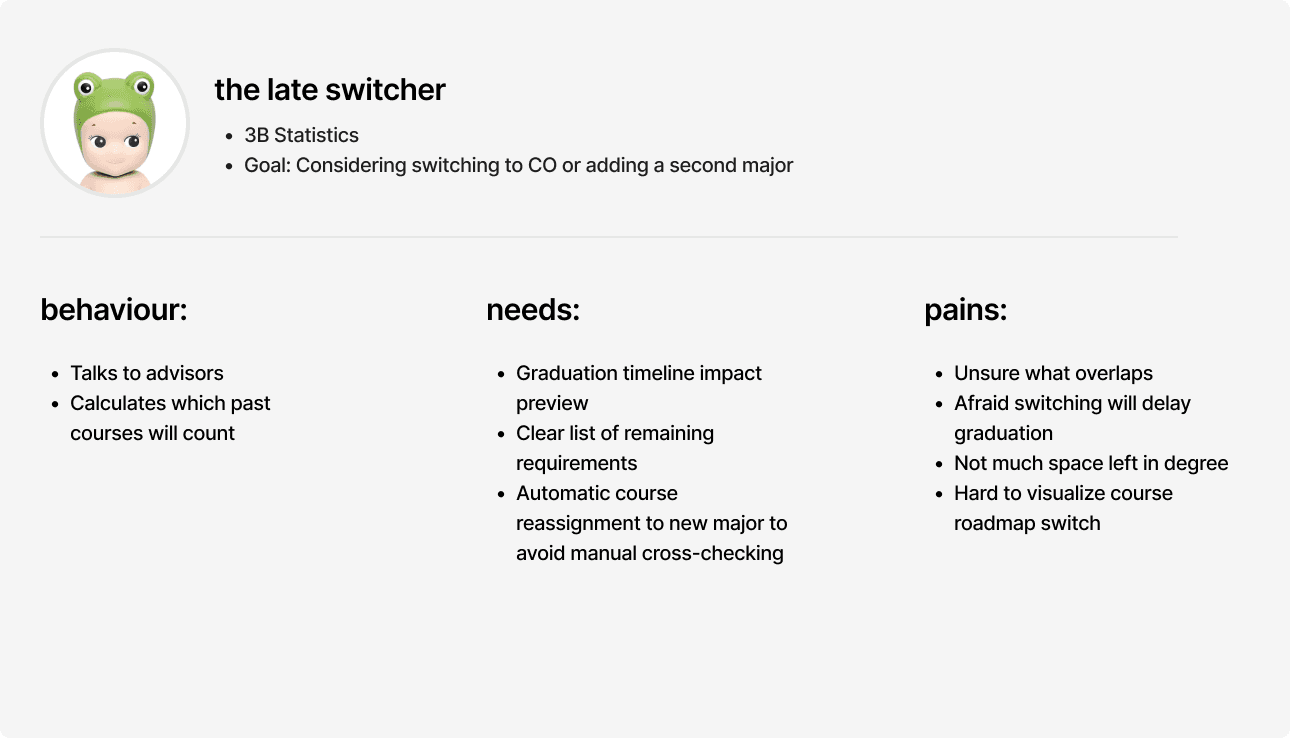
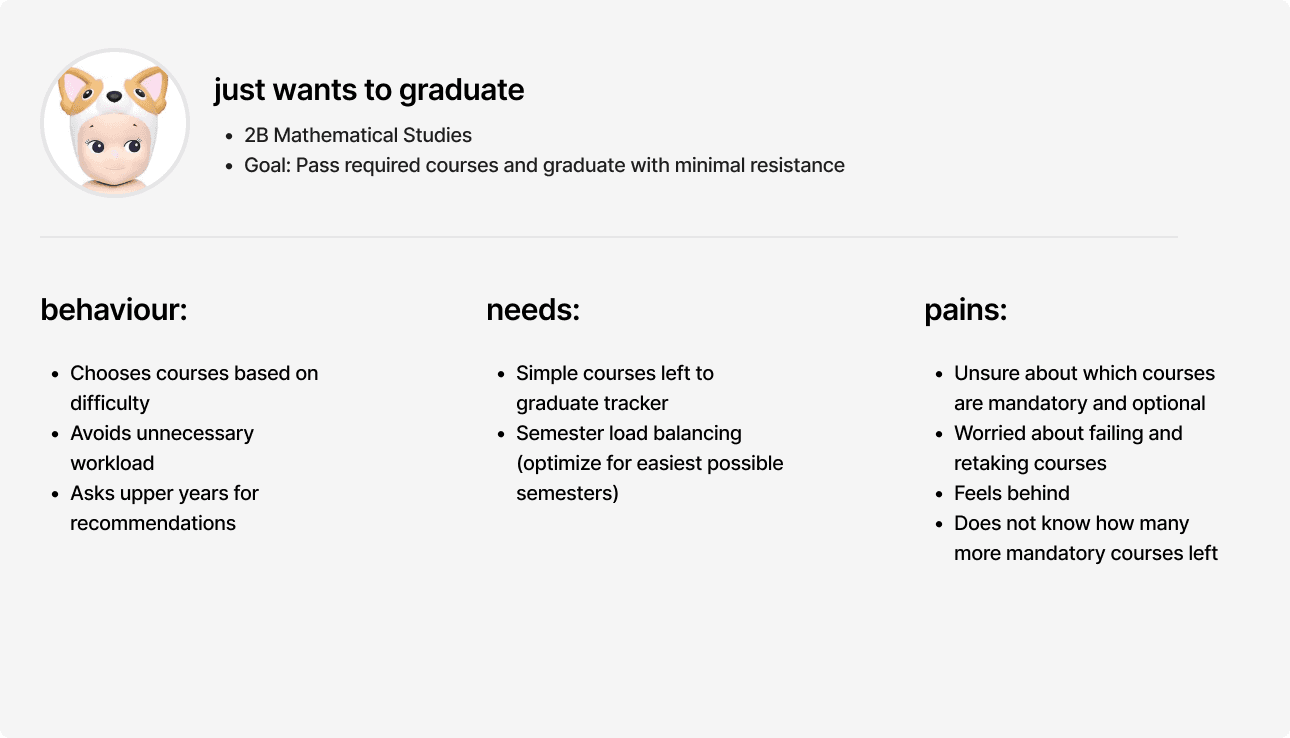
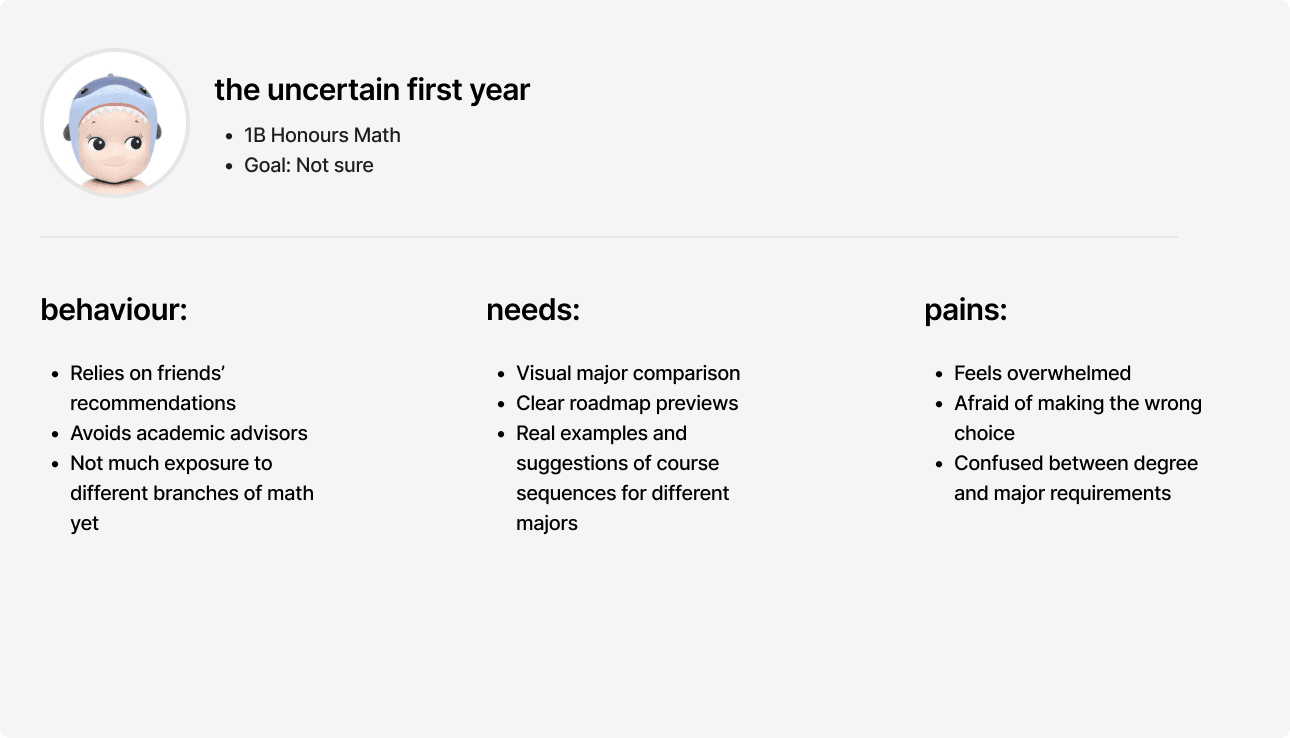
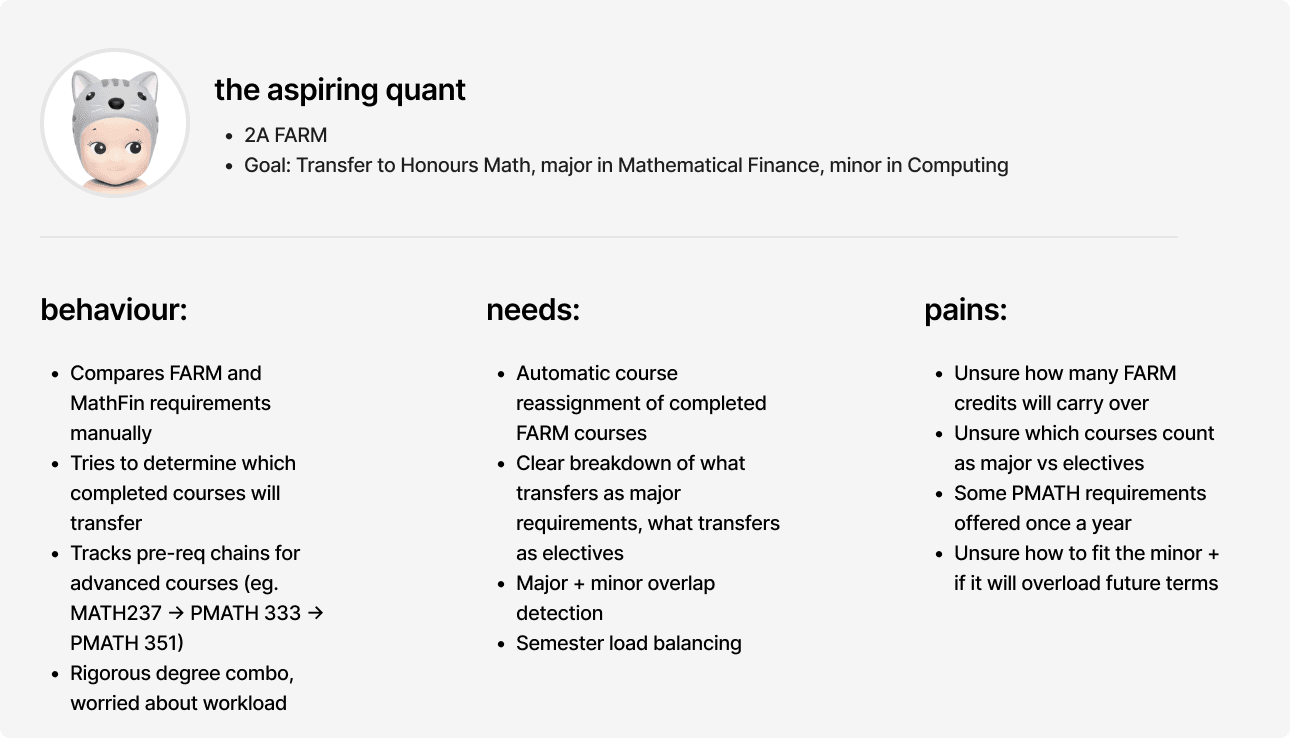
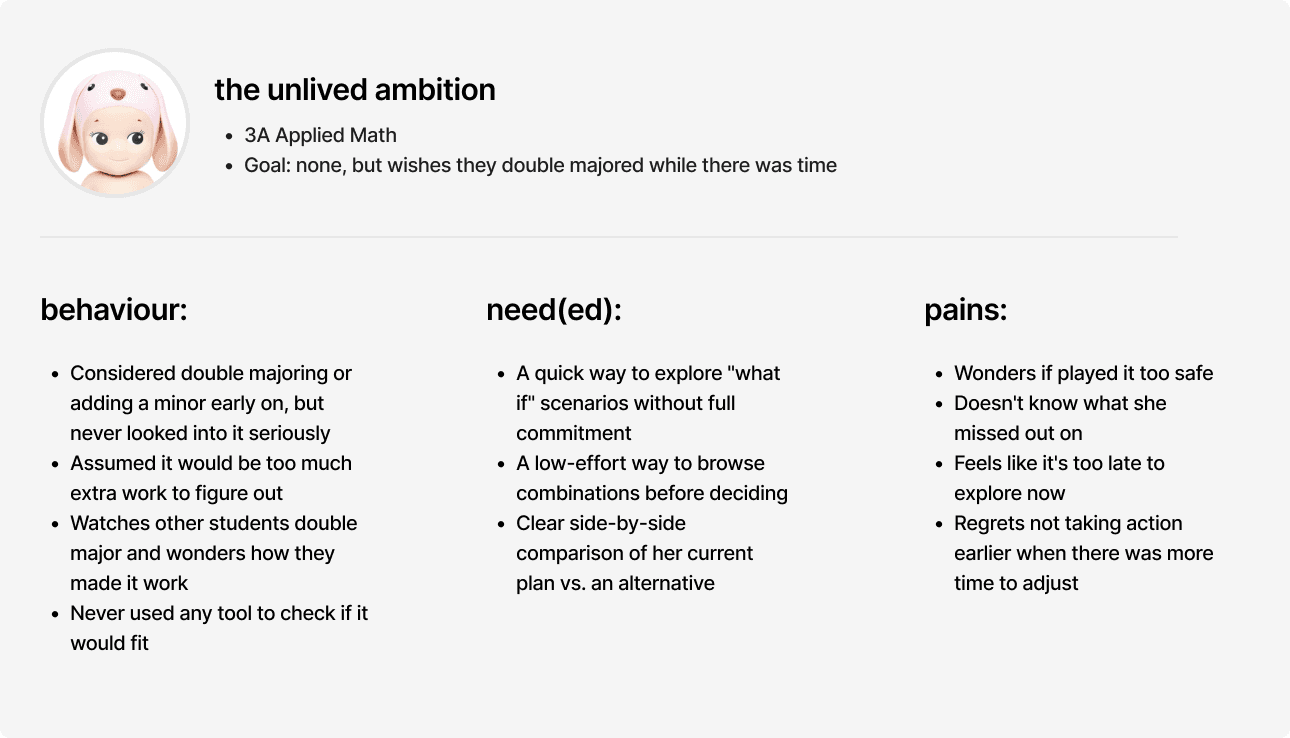
key insights
Math students have 5 tools open when planning their courses. None of them talk to each other, know what you've taken, or know what you need.
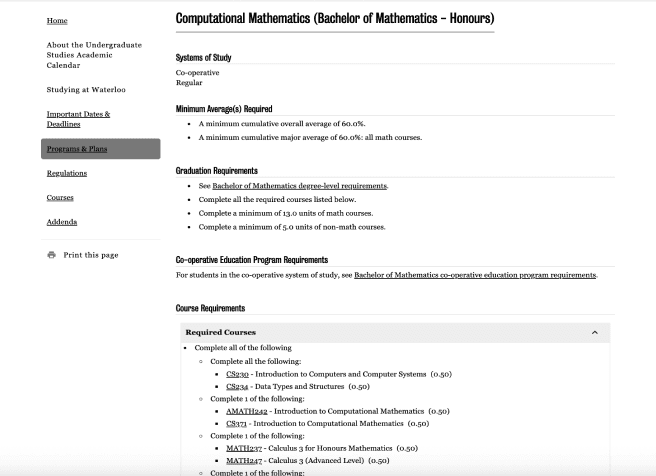
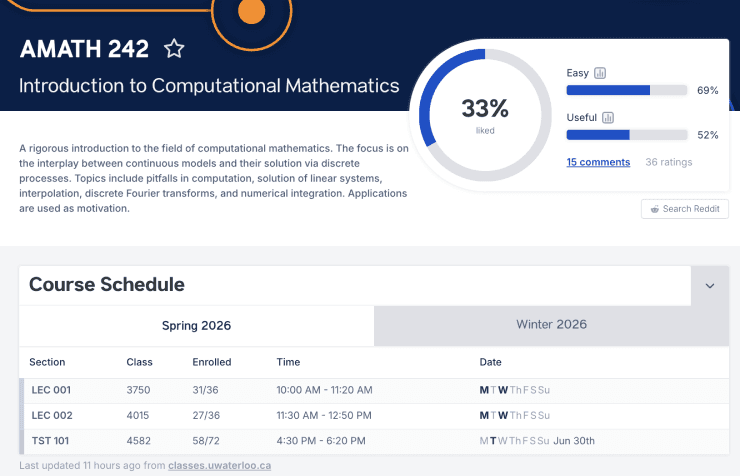
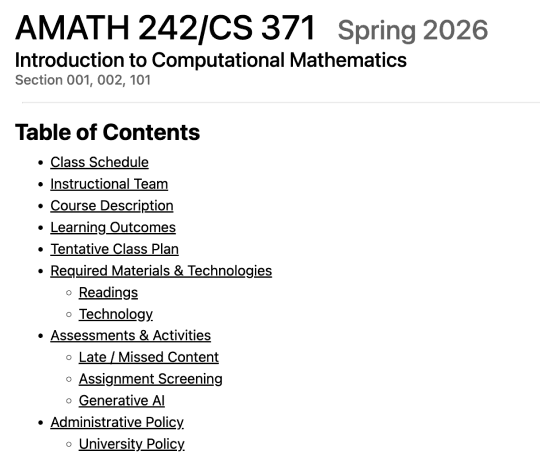
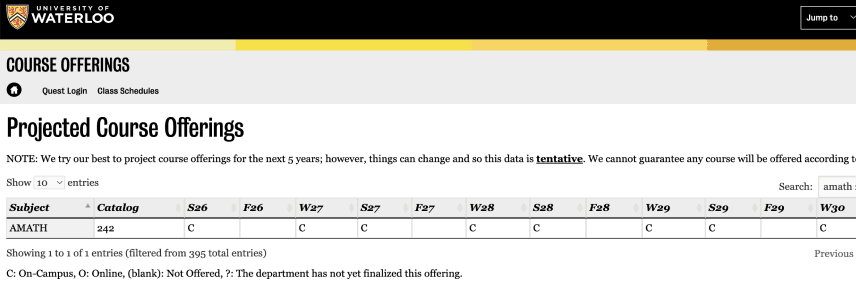

Even with 16 major choices, math students like taking the path of least resistance. But what if we were meant for more?
Cross-referencing requirements manually across 5 tools is so tedious that students are being deterred from taking advantage of the endless possibilities and flexibility Honours Math provides. With so much else on their plate, most students never even bother checking if an ambitious degree combination could fit.

solution
Pink Tie Planner turns degree planning into one unified experience.
Pink Tie Planner knows who you are.
Upload your transcript once to map your completed courses to your plan requirements.
Pink Tie Planner brings every tool together.
The Undergraduate Calendar, UW Flow, UW Outline, Odyssey projected offerings, and your personal planning system all in one place, personalized to your program and your progress.
Pink Tie Planner allows you to be curious.
Curious if a double major or minor fits? Try out different plans and see how your requirements change without manual cross-referencing.
design decisions
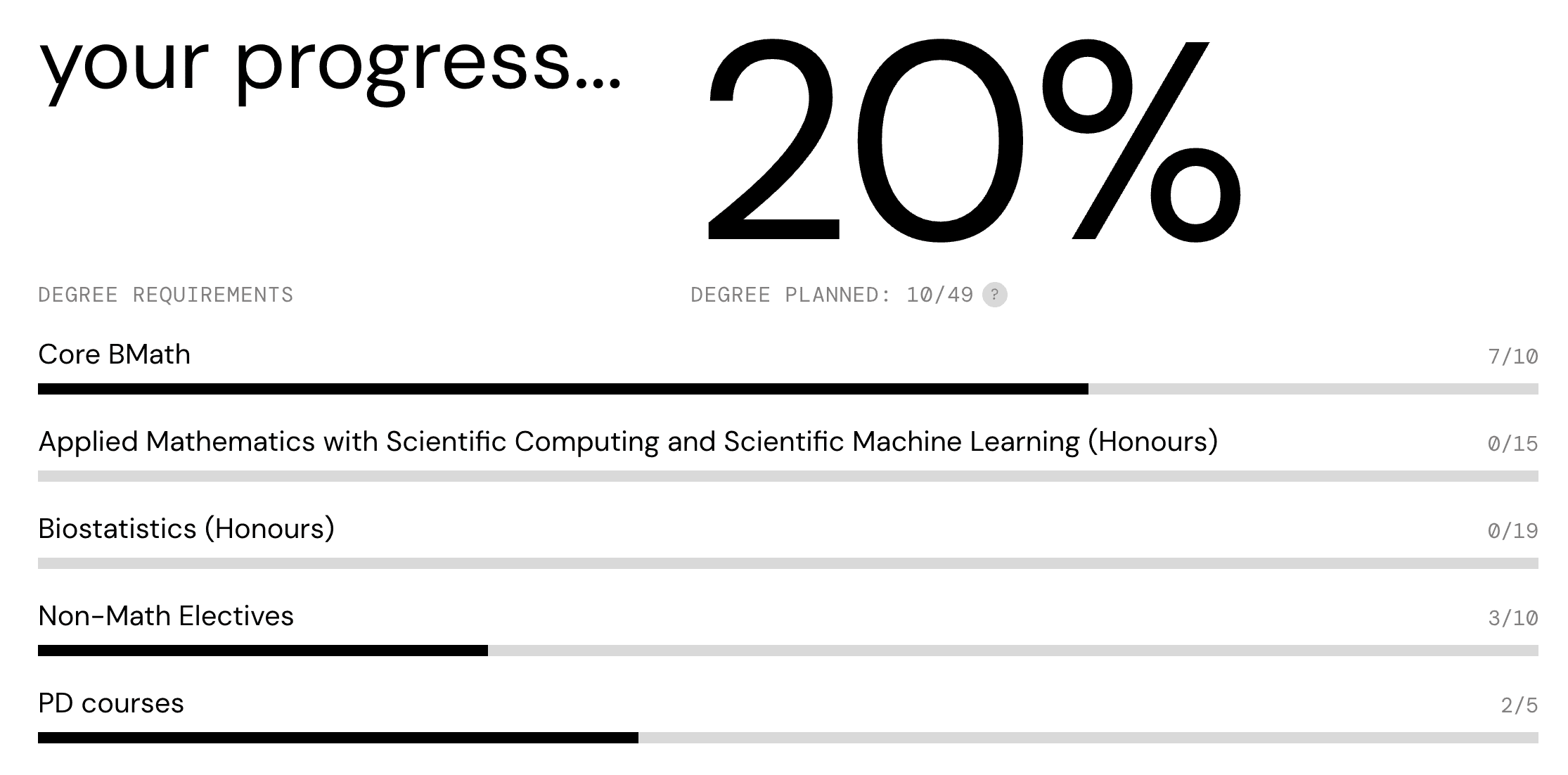
Visual communication to reduce cognitive overload and increase validation
Category-specific progress bars, clear metrics, and checkbox-style validation allow instant visual confirmation of where students stand in their degree.
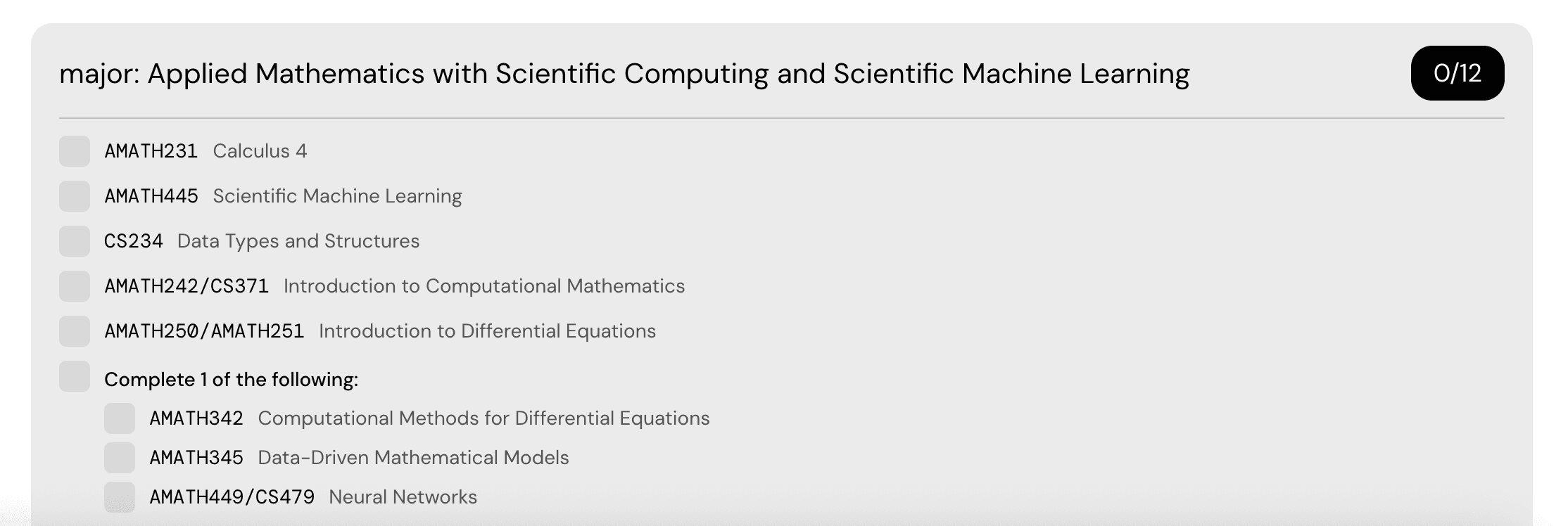
Toggles instead of separate pages
Students stay on the same page with the same context while answering different questions, reducing the key pain point of tab switching.
challenges
The technical complexity of the requirements logic
Wiring up the complicated nested conditional logic trees across 111 different programs proved to be super messy, and I didn't have the technical expertise to fully resolve a lot of the logic issues. With 16 majors, hundreds of minors, and a seemingly infinite amount of degree combinations, there was no way I could hit every edge case.
I couldn't have done it alone!
To address this, I opened up Pink Tie Planner to the community for user testing. Each person who helped test it brought a unique degree combination that I couldn't have tested myself, turning users into collaborators, receiving unique perspectives and use cases well beyond what I could have done on my own.



Impact + next steps
Pink Tie Planner continues to help math students explore their degree plans as more features are shipped and more feedback is taken. Coverage for the rest of the math faculty + double degrees is coming as soon as secondary features are added to the MVP.
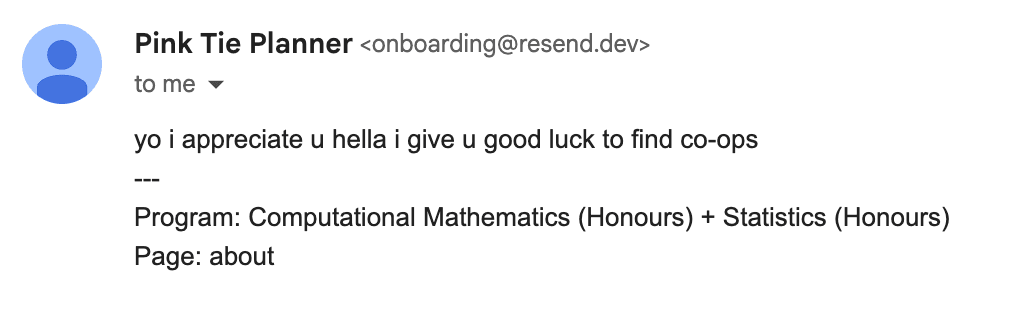
what makes it all worth it :)
reflection
As this project marks the start of my pivot into UX and product design, I still see January me, lost in SWE and data job applications, blindly praying that jumping into something I knew nothing about was the right move. Spending a term going through the end-to-end UX lifecycle + shipping the project in code has taught me immensely about the design process.
Individuality as a design tool
Each math student has a different degree combination. The strongest insights came from the convergence of pain points across very different students, and opening the project up for user testing let that same individuality work in my favour to catch edge cases.